
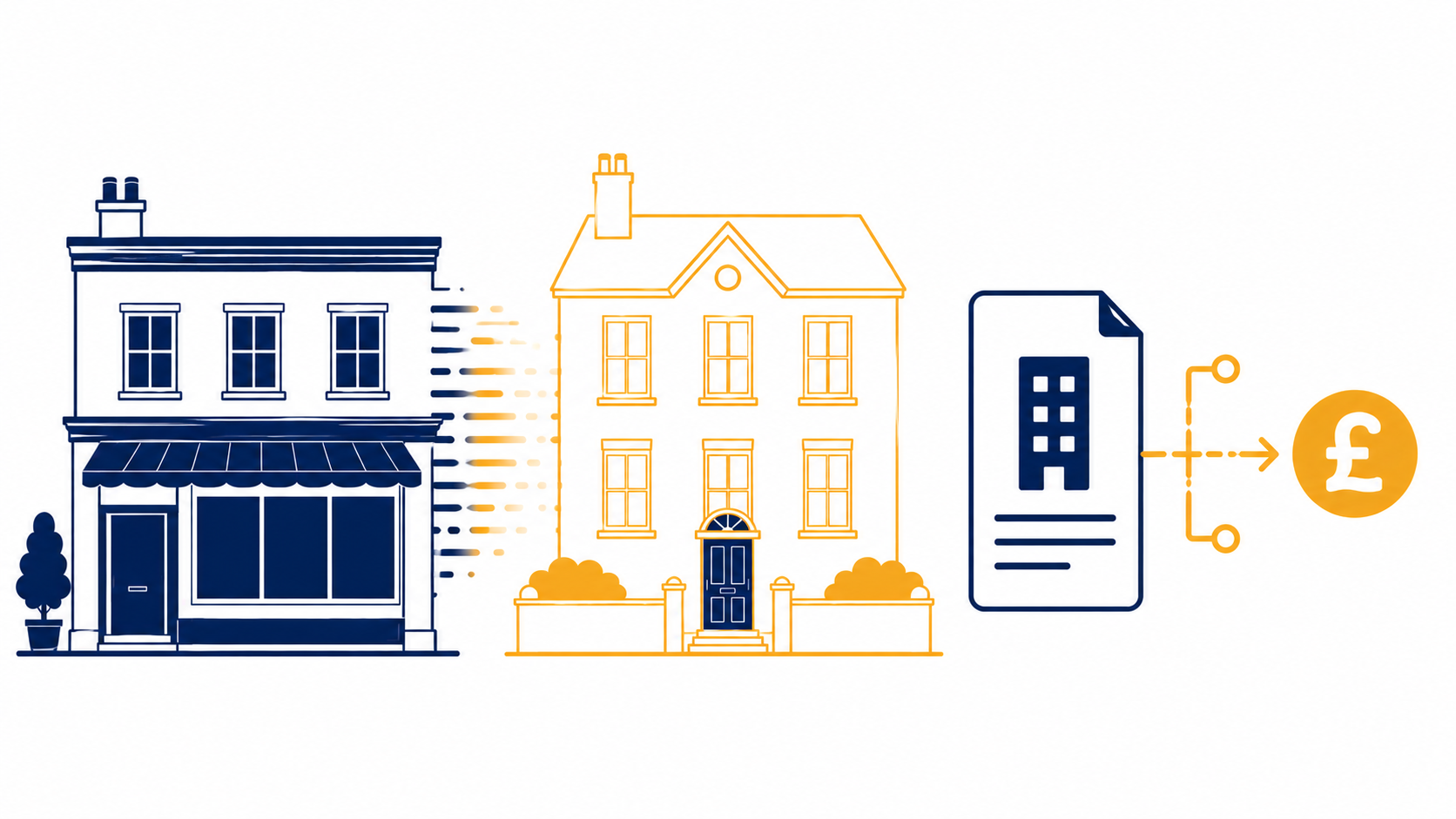
A shop becoming a house, a barn becoming holiday lets, an office block becoming flats: “change of use” covers an enormous range of projects, and the fee genuinely depends on which of three very different calculation methods your specific change falls under. Get the category wrong and you’ll either underpay (leading to a validation delay) or overestimate your budget by a wide margin.
Three ways this fee is worked out
Unlike a householder extension, where one flat number covers every project, change of use splits into three distinct calculation routes:
- Changing use to one or more dwellinghouses, priced per dwelling, using the same banding as new build homes
- Waste use (disposal of refuse, deposit of extraction residue, or open storage of minerals), priced by site area
- Any other change of use, a flat £610, covering everything that doesn’t fall into the two categories above
Changing use to dwellings
If your project converts a building into residential use (an office into flats, a redundant chapel into a house, a barn into a home), the fee follows the same per-dwelling structure used for new build houses:
- 1 to 9 dwellings: £610 each
- 10 to 50 dwellings: £659 each
- Over 50: £32,578 plus £196 per dwelling above 50, capped at £427,537
The detail almost every guide misses
If the change is between two residential uses, say, converting a large single dwelling into several smaller ones, the fee is charged only on the additional dwellings created, not the total number of units after conversion. Splitting one house into three counts as 2 additional dwellings for fee purposes, not 3, since one dwelling already existed before the change. This distinction genuinely changes the total: at the standard rate, that’s £1,220 rather than £1,830, a meaningful difference for a project that might otherwise look identical to a straightforward flats conversion on paper.
Waste use, a fee category most homeowners will never encounter but worth knowing exists
Changing land use to dispose of refuse or waste, deposit extraction residue, or store minerals in the open is charged by site area rather than by unit count:
- Up to 15 hectares: £333 per 0.1 hectare
- Over 15 hectares: £49,786 plus £196 per 0.1 hectare above 15, capped at £111,159
This is a specialist, industrial-scale category, not something a typical homeowner or small developer will run into, but it’s worth knowing it exists as its own distinct banding, separate from every other change-of-use fee on this page. It’s easy to assume “site area” always means the outline-permission rate covered elsewhere on this site. It doesn’t; waste use has its own separate rate structure entirely.
Everything else: the flat £610 catch-all
Any change of use that doesn’t fit the two categories above (a shop becoming a restaurant, a warehouse becoming a gym, agricultural land becoming a commercial yard) is charged a flat £610, regardless of the scale of the change. A single shop unit changing use and a large industrial building changing use both pay the same £610, provided neither falls into the dwellings or waste categories.
A project that can trigger more than one fee
Change of use is one of the few application categories flagged as commonly involving multiple fee elements in a single submission. A building converting from commercial use into 6 flats, for example, might combine:
- The change-of-use element itself (potentially assessed under the dwellings banding, at 6 × £610 = £3,660)
- A separate Prior Approval route, if the specific building type qualifies for one (commercial-to-residential conversions under Class MA often do; see our Prior Approval guide for when that applies instead)
- Additional physical building operations, if the conversion involves more than internal alteration
Where more than one of these genuinely applies, each element is typically assessed and charged separately, not combined into a single reduced fee. It’s worth working through which specific elements your project actually involves before assuming one number covers everything.
Worked example
A disused pub is converted into 4 flats, involving a genuine change of use from commercial to residential, with no qualifying Prior Approval route available for this particular building type.
- Dwellings created: 4
- Banding: under 10 dwellings, £610 each
- Fee: 4 × £610 = £2,440
Had the same pub instead been converted into a single house rather than flats, the fee would drop to £610. One dwelling created, one unit charged, even though the physical scale of the conversion work might be broadly comparable.
Why this category deserves extra care before submitting
Because three genuinely different calculation methods sit under one label, “change of use” is one of the easier categories to submit with an incorrect fee attached, not from carelessness, but because the category genuinely does require correctly identifying which of the three routes actually applies before the number can be worked out at all. Getting this wrong at submission risks the validation delay and correction process covered elsewhere on this site, on top of simply losing time.
For the official position on change of use and when Prior Approval might apply instead, see Planning Portal’s guidance. For the current fee schedule, see Gov.uk: Fees for planning applications.
Not sure which of the three change-of-use categories applies to your project? Use the calculator to get the correct fee.