
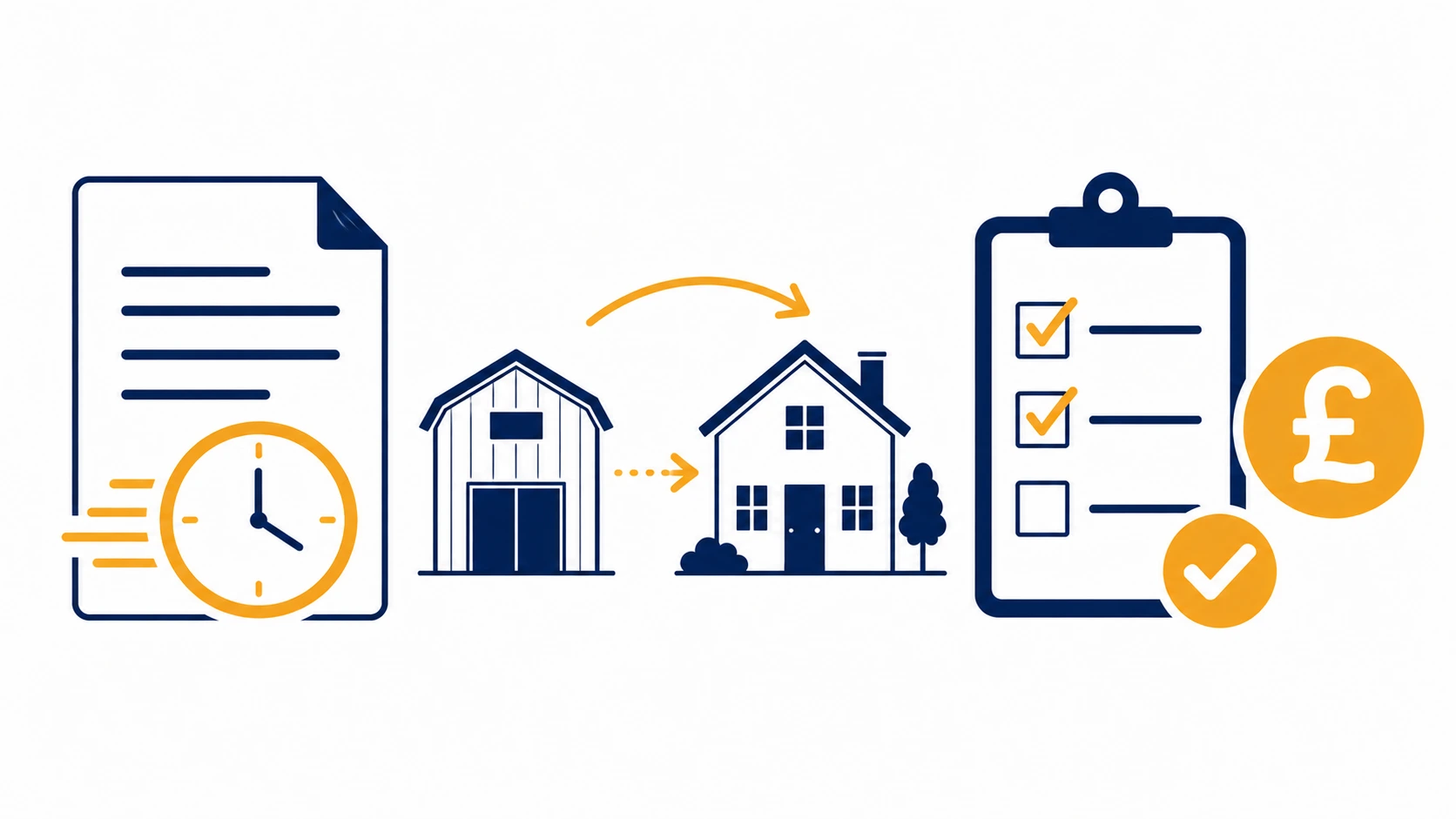
Two building operations, same physical scale, same underlying legislation, and one costs £249 while the other costs £536. The difference isn’t the size of the project. It’s whether building work is actually involved in delivering it, a distinction that runs through nearly every Prior Approval category and catches people out more often than the headline fee figure ever suggests.
What Prior Approval actually is
Most planning applications ask a broad question: is this development acceptable? Prior Approval asks something much narrower. The principle of the development is already settled through permitted development rights, so the council can only assess a specific, predefined set of matters, things like design, flooding risk, contamination, or transport impact, depending on the category. It can’t reopen the whole scheme the way a full application would.
That narrower scope is exactly why the process moves faster and costs less than most alternatives.
The categories, and the building-operations split
Several Prior Approval categories carry two different fees depending on whether physical construction is part of what’s being proposed:
- Larger home extension, single-storey rear extensions beyond standard permitted development limits: £249
- Additional storeys added to an existing house: £249
- Betting shop, pay-day loan shop, launderette, or hot food takeaway converting to dwellings, without building operations: £249
- Same conversion, with building operations included: £536
- Amusement arcade or casino converting to dwellings, without building operations: £249
- Same conversion, with building operations included: £536
- Agricultural building converting to dwellings, without building operations: £249
- Same conversion, with building operations included: £536
- Class E commercial, business, or service premises converting to homes: £260 per dwelling created
Why “with building operations” roughly doubles the fee
A conversion that changes use without touching the physical structure, simply reclassifying an existing space, needs less council scrutiny than one where walls are coming down, new openings are being formed, or the building’s external appearance is changing. The higher fee reflects the extra assessment that genuine construction work requires, even within the same permitted development class. Two applications for what looks like the same end result on paper can sit in entirely different fee bands depending on this single distinction.
The 56-day deadline, and what happens if it’s missed
Prior Approval applications typically carry a 56-day decision deadline. If the council doesn’t determine the application within that window, and no extension has been agreed, the development can generally proceed as though approved. This deemed approval mechanism doesn’t really exist in the same form for standard planning applications, and it’s one of the clearest practical advantages of the Prior Approval route over a full application, where an undetermined application simply sits open indefinitely.
Neighbour consultation still matters
Most Prior Approval categories involve a neighbour consultation period, commonly around 21 days, before a decision is reached. If a neighbour raises an objection on a ground the council is actually permitted to consider under that category, it can lead to refusal even though the broader principle of the development was never in question. The narrower scope of what the council can assess doesn’t mean nobody else gets a say.
Class MA, the largest and most complex category
Converting Class E premises, shops, offices, and similar commercial, business, or service uses, into homes deserves its own separate mention, since it’s charged per dwelling rather than as a fixed amount. Converting a single unit into one flat costs £260. Converting the same building into 4 flats costs £1,040. Because this route sits under Prior Approval rather than full planning permission, it’s often significantly cheaper than a comparable full application achieving the same outcome, provided the specific building and location genuinely qualify.
A worked comparison across the fee split
Two agricultural barns on neighbouring farms both convert into a single dwelling under Class Q.
Barn one needs only internal reconfiguration, no external structural changes, no new openings. Fee: £249.
Barn two needs a new roof structure and additional external openings to make the space habitable. Fee: £536.
Both barns end up as a single home. Both used the same Prior Approval class. The fee more than doubled based entirely on whether construction work was genuinely part of the proposal, a distinction worth confirming carefully before assuming which figure applies to a specific project.
Where Prior Approval sits relative to other categories
It’s worth being clear about what Prior Approval isn’t. Unlike a householder application, which covers alterations to an existing single house at a flat £548, Prior Approval only applies to the specific permitted development classes set out in legislation, each with its own conditions and its own fee. And unlike a full or outline application, where the council can assess the whole scheme, Prior Approval’s review is deliberately limited to the matters that specific class allows.
Choosing the wrong category isn’t just a fee mistake. It can mean submitting an application type that doesn’t actually apply to the project at all.
For the official list of Prior Approval categories and their conditions, see Planning Portal’s guidance. For the current fee schedule, see Gov.uk: Fees for planning applications.
Not sure which Prior Approval category, or which fee within it, applies to your project? Use the calculator to confirm.