
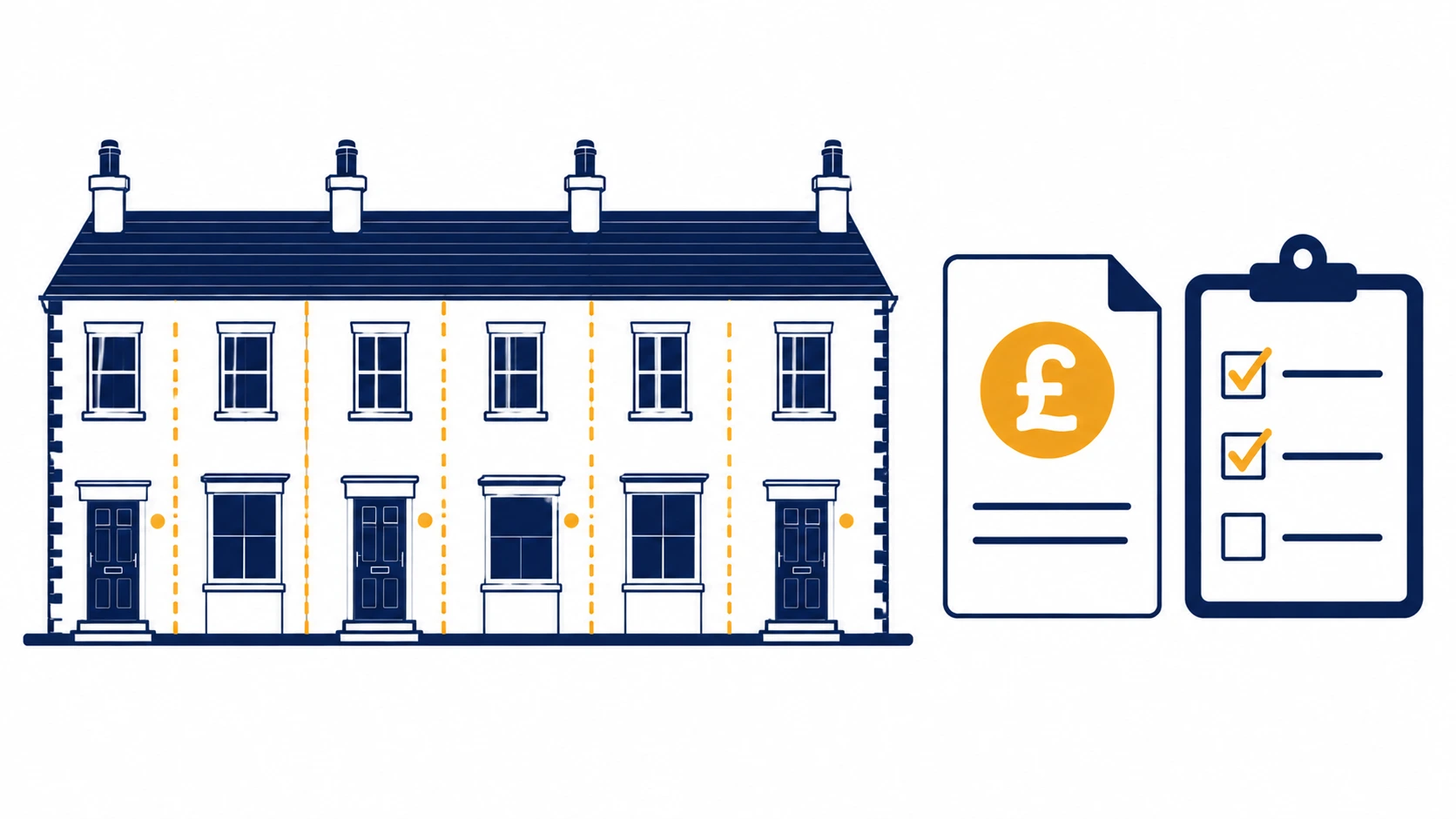
Three flats out of one house sounds like a single project. To your council, it’s three separate dwellings being created, and the fee reflects that directly — £1,830 at the standard rate, not a flat fee for “the conversion” as a whole. Every unit you create counts individually, which is the single most important thing to understand before budgeting this kind of project.
This is a full planning application, not a householder one — a genuinely different process from anything else in the extension or loft conversion category, with its own fee logic entirely.
The banding, based on how many flats result
- 1–9 resulting flats: £610 each
- 10–50 resulting flats: £659 each
- Over 50: £32,578 plus £196 per flat above 50, capped at £427,537
A conversion creating 3 flats: 3 × £610 = £1,830. Creating 12 flats instead pushes every unit into the higher band: 12 × £659 = £7,908 — not just the units past 9, the entire scheme moves up together, the same threshold behaviour that applies to new build fees.
Why there’s no permitted development shortcut here
This surprises people who’ve heard about permitted development routes for other conversions — a shop or office converting to residential under Class MA, for instance, sometimes skips full planning permission entirely. Converting an existing house into multiple flats doesn’t have an equivalent shortcut. There’s no permitted development class covering residential-to-residential subdivision of a single dwellinghouse, regardless of how straightforward the physical work is. Every flat-conversion project of this kind needs a full application, and the fee above applies in full, every time.
Article 4 Directions make this stricter still, in some areas
Many councils — particularly in areas with a lot of existing shared housing — have issued Article 4 Directions specifically targeting residential conversions, removing what limited permitted development rights might otherwise apply nearby (this is more commonly relevant to HMO conversions than flats, but the two get caught in the same local policy discussions). Where an Article 4 Direction is in place, a council can also apply closer scrutiny to flat-conversion applications generally, on design and amenity grounds. It’s worth checking your specific council’s Article 4 status before assuming a straightforward approval, even though the fee itself doesn’t change either way.
What actually counts as a self-contained flat
The per-dwelling fee applies specifically to units that are genuinely self-contained — each with its own kitchen, its own bathroom, and its own means of access, even where that access is an internal front door off a shared communal hallway rather than a separate street entrance. This is the same underlying test used elsewhere in planning law to distinguish a real dwelling from a room or an annexe: could this unit function as an independent home on its own?
If the work falls short of that — shared kitchen facilities between units, for instance — it likely isn’t a flats conversion in the planning sense at all, and falls into the HMO category instead, covered next.
Flats and HMOs are not the same thing — and the fee logic differs
Worth being precise about this, since the terms get used loosely. A flat conversion creates fully self-contained units, each counted individually for fee purposes as shown above.
A House in Multiple Occupation (HMO) is different: rooms let separately to unrelated tenants who share facilities like a kitchen or bathroom. It isn’t creating new dwellings in the same legal sense, so it’s assessed differently — typically under a “material change of use” fee of £610 flat, rather than the per-dwelling banding that applies to genuine flat conversions. If your project is actually an HMO rather than a flats conversion, this article’s per-dwelling fee structure doesn’t apply to you at all.
How councils tell the difference in practice
In borderline cases, councils look past what the application calls the project and assess what’s actually being built: separate kitchens and bathrooms per unit point toward flats; shared facilities point toward an HMO. Getting this classification wrong on your application isn’t just a paperwork issue — since the two categories are charged differently, submitting under the wrong one can mean paying an incorrect fee, which brings its own complications at validation stage.
Retrospective conversions — the trap worth knowing about upfront
Occasionally a property gets converted into flats first, with planning permission sought, or discovered to be needed, afterward. The fee itself doesn’t punish this: a retrospective application is charged exactly the same as a normal one, so a 3-flat conversion submitted retrospectively still costs £1,830, not more. What genuinely changes is the risk sitting underneath that fee.
Unlike a simple extension, where a refusal just means the structure needs modifying, a refused retrospective flats conversion can mean an enforcement notice requiring the property to be reverted back to a single dwelling, undoing multiple kitchens and bathrooms, and potentially requiring tenants already living there to vacate. That’s a substantially higher-stakes outcome than the fee alone would ever suggest, which makes confirming the correct application route before converting, not after, the genuinely important precaution here. See our guide on the retrospective planning application fee for the full detail on how retrospective applications and enforcement risk actually work.
A conversion that crosses a real threshold
A landlord converts a large Victorian terrace into 4 self-contained flats. Under the per-dwelling banding: 4 × £610 = £2,440.
Compare that to converting the same house into just 2 flats — a much smaller-scale change to the building’s internal layout — at 2 × £610 = £1,220. The fee scales cleanly with the number of separate legal dwellings the work creates, independent of how much physical construction is actually involved in getting there. Two conversions of similar physical complexity can carry very different total fees purely based on how many units they end up producing.
Building regulations sit alongside this, not instead of it
Beyond planning permission, converting a house into flats always triggers Building Regulations approval — fire separation between units, sound insulation between floors and walls, means of escape in the event of a fire, and often ventilation and access requirements that don’t apply to a single dwelling. This is a separate consent, with its own separate fee, assessed by a different part of the council (or an approved inspector) entirely from the planning department.
Once complete, each flat typically also becomes individually assessed for Council Tax, replacing the single band that applied to the original house — a downstream cost worth factoring in when weighing up whether a conversion project makes financial sense overall, even though it sits outside the planning fee itself.
For the official position on change-of-use applications creating additional dwellings, see Planning Portal’s guidance. For the current fee schedule, see Gov.uk: Fees for planning applications.
Not sure how many resulting flats your conversion will create, or which fee band it falls into? Use the calculator to get the exact figure before you apply.