
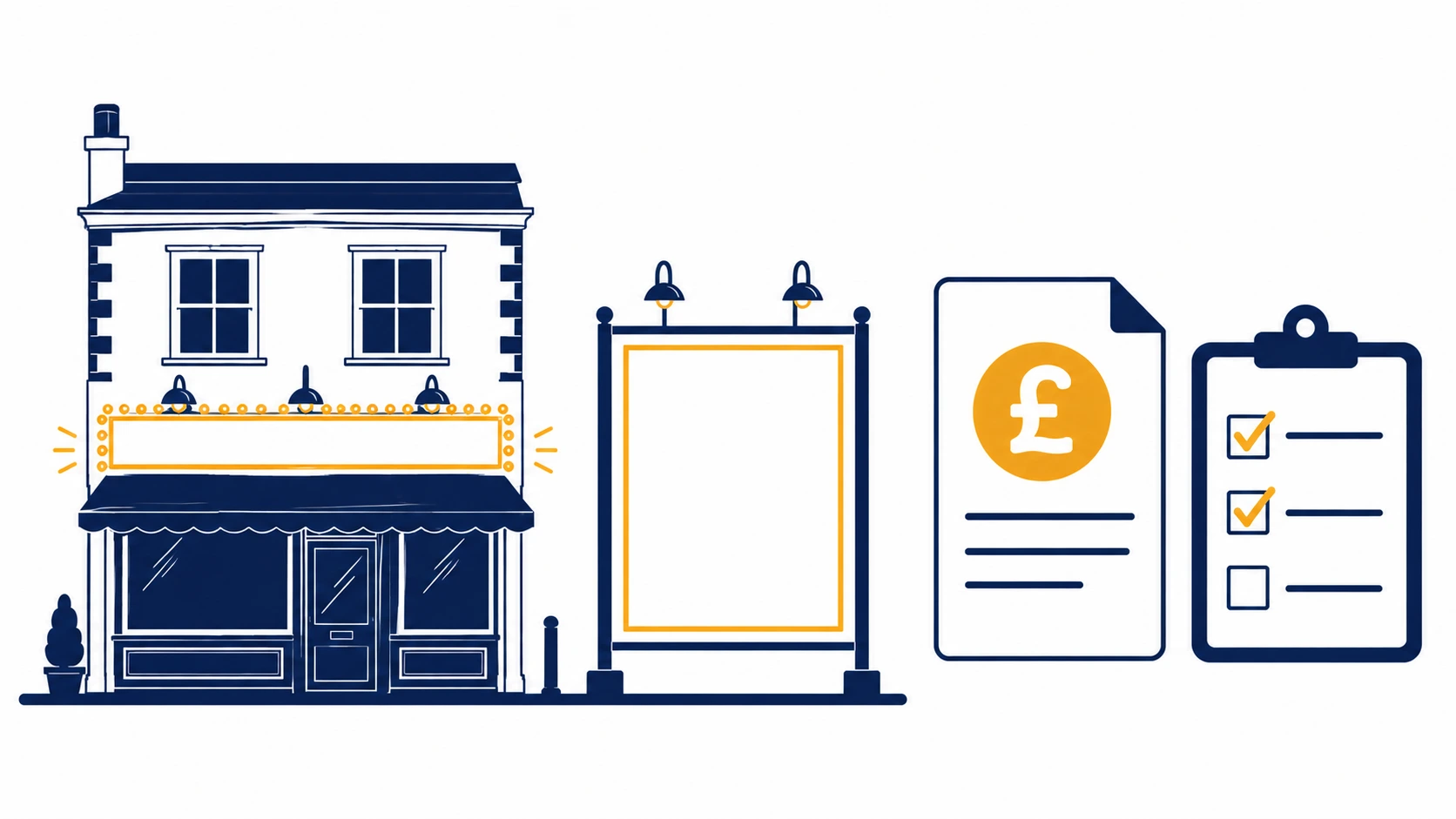
Put a sign above your own shop advertising your own business, and the fee is £174. Put up almost any other kind of sign — a hoarding, a poster site, a large-format advert unrelated to what’s actually on that plot — and the fee jumps to £610. Same council process, same category of consent, more than three times the cost, based entirely on what the sign is actually for.
This is a fee category most people never think about until they’re staring at a shopfront redesign or a new hoarding — at which point the £174 vs £610 distinction becomes very relevant, very quickly.
Why signs need their own consent at all
Advertisement consent exists separately from planning permission because it’s governed by different regulations — the Town and Country Planning (Control of Advertisements) (England) Regulations 2007, not the same fee regulations that cover extensions or new builds. The concern here isn’t building work; it’s visual impact, public safety (particularly sign visibility and traffic), and amenity.
That’s why a business can have full planning permission for its premises and still need a completely separate advertisement consent before putting up signage.
The two fee tiers
- £174 — advertisements relating to the business actually on the premises, or advance directional signs guiding the public to a business (even if the sign itself isn’t at that business’s location)
- £610 — essentially everything else: freestanding hoardings, poster sites, and advertisements not tied to an on-site business
The £174 rate exists because these are, in effect, the most routine and lowest-risk category of advertisement — a shop sign for the shop it’s attached to. The £610 rate reflects the broader category of advertising that isn’t self-evidently tied to what’s on that specific site, and therefore needs closer scrutiny.
A shopfront and a billboard, side by side
A café owner wants a new illuminated sign above their door, showing the café’s name and logo. That’s on-premises advertising: £174.
Across the street, a different applicant wants to erect a freestanding billboard on a vacant plot, to be rented out to whichever advertiser pays for it. That’s not tied to any business on that site: £610.
Both are advertisement consent applications, assessed by the same council team, under the same regulations — but one is priced at nearly three and a half times the other, because of what the advertisement is actually doing.
Does every sign need consent?
No — a meaningful number of business signs fall under “deemed consent,” a category that doesn’t require a formal application at all, provided the sign meets specific size, illumination, and positioning rules set out in the regulations. A small, non-illuminated sign of modest size, fixed flat against a shopfront, is often covered this way.
Where deemed consent doesn’t apply — larger signs, illuminated signs beyond permitted limits, or signs in a Conservation Area — a formal application, and one of the two fees above, becomes necessary.
Consent doesn’t last forever
Advertisement consent, once granted, typically lasts five years, after which it needs renewing. This is different from standard planning permission, which — once implemented — generally doesn’t expire in the same way. A business that’s had the same sign up for a decade without ever renewing consent may technically be in breach, even if nothing about the sign has changed.
For the official position on advertisement consent and deemed consent categories, see Planning Portal’s guidance.
Not sure which category your sign falls into? The calculator above will confirm the correct fee once you specify the advertisement type.