
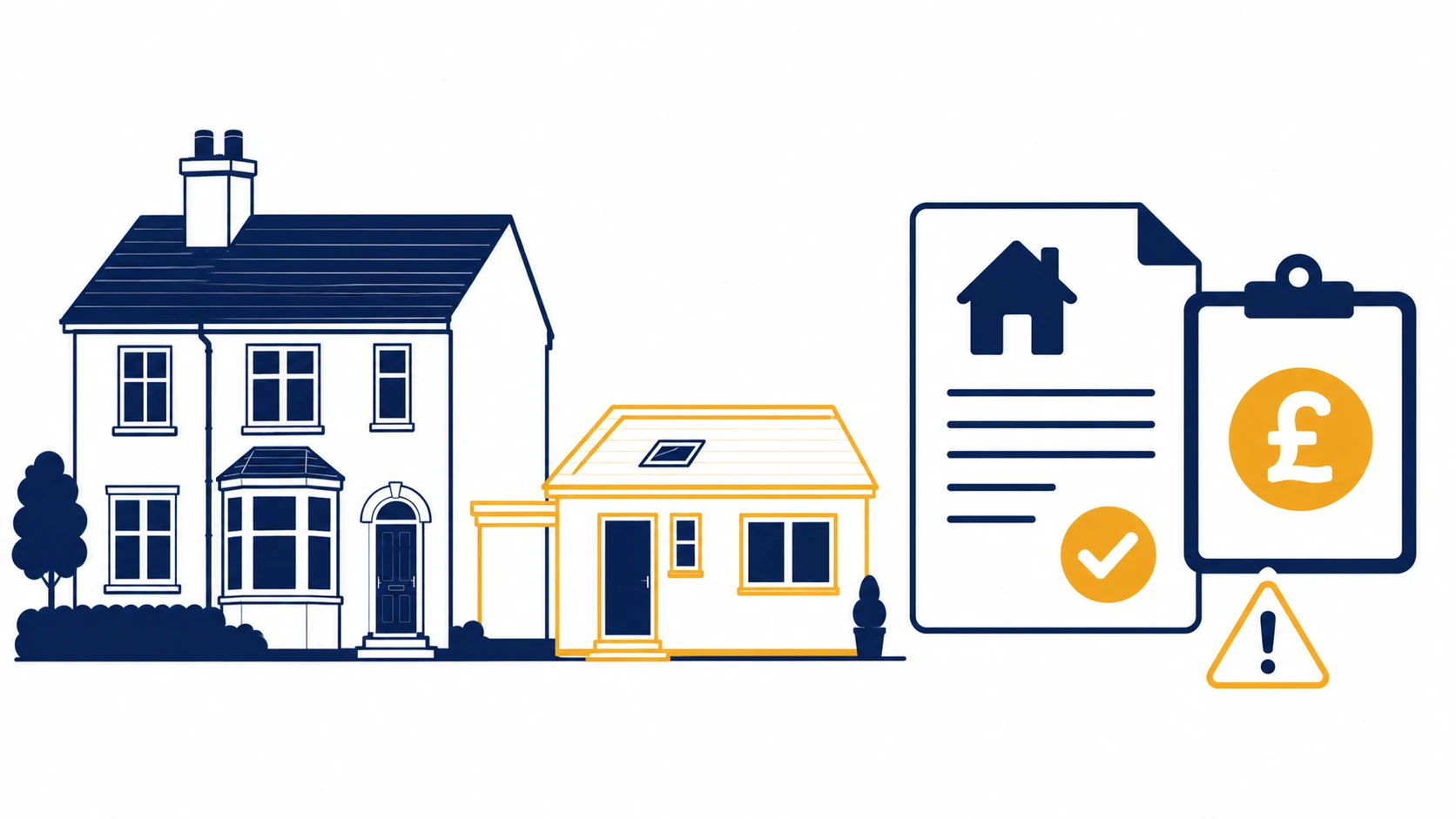
For most annexes built within the curtilage of your existing house — even self-contained ones with their own kitchen and bathroom — the planning fee is the same £548 householder rate that applies to extensions, provided the annexe remains legally tied to the main house as ancillary accommodation.
The real cost surprise with annexes usually isn’t the planning fee. It’s Council Tax — a self-contained annexe can be given its own Council Tax band, separate from your main home, regardless of what you paid to build it.
👉 Use the calculator to confirm your exact fee
The test that decides everything: incidental vs self-contained
A garden room, office, or gym is judged “incidental to the enjoyment of the dwelling” — it supports the use of the house, but isn’t a home in its own right. An annexe is different specifically because it usually has:
- Its own kitchen
- Its own bathroom
- A separate entrance (this doesn’t have to be external — internal separation can be enough)
- The practical capability of being lived in independently
Once a structure meets that test, it’s treated in planning terms as ancillary residential accommodation — not a garden building. It almost always needs planning permission, and it’s this self-contained status, not the size of the building, that changes both the planning process and the ongoing Council Tax position.
The occupancy condition — the detail that protects the £548 rate
When councils grant permission for a self-contained annexe, they typically attach an occupancy condition (sometimes called an ancillary use condition), stating the annexe can’t be occupied independently of the main house — it can’t be sold or let separately as its own dwelling.
This condition is what keeps the application in householder territory at £548, rather than being assessed as creating a genuinely new, independent dwelling. If you later want to rent the annexe to someone unconnected to the household, or sell it separately, that condition would need to be formally varied or removed — a separate process with its own fee, not something to assume happens automatically.
A lesser-known route: the Caravan Act exemption
One route some annexe builders use deliberately: under the Caravan Sites and Control of Development Act 1960, a structure built to specific caravan dimensions (broadly, no larger than 20m × 6.8m × 3.05m, in no more than two sections) can be sited on a residential plot without planning permission at all, provided it’s for use by a dependent relative. Some manufacturers design “mobile” annexes specifically to sit within these limits for exactly this reason. It’s a narrow, dimension-specific exemption — worth checking against your actual planned footprint before relying on it.
Council Tax: the cost that actually catches people out
Because a self-contained annexe is classed as separate living accommodation, the Valuation Office Agency can assess it for its own Council Tax band, independent of your main home’s band. Two reliefs are worth knowing:
- Full exemption — where the annexe is occupied by a dependent relative (typically someone 65+, or someone with a significant disability)
- 50% discount — where the annexe is used by the main household as extra space (a family member, a home office/guest suite), without being fully separate
Rent the annexe to someone with no family connection to the household, and neither relief applies — the annexe becomes liable for its own full Council Tax bill.
Worked example
A family builds an attached annexe for an elderly parent, with its own kitchen, bathroom, and internal separate entrance.
- Planning fee: £548 (householder application)
- Occupancy condition attached: annexe tied to use by a dependent relative
- Council Tax: full exemption applies, since it’s occupied by a dependent relative as defined by the council
Had the same family built an identical annexe purely to earn rental income from an unrelated tenant, the fee itself might still be £548 at the application stage — but the Council Tax exemption wouldn’t apply, and the council may scrutinise the application more closely given the clearer break from “ancillary” use.
CIL — worth checking before you build
Depending on your local authority, a self-build annexe may qualify for a Community Infrastructure Levy (CIL) exemption if you own and live in the property — but this must generally be claimed before work starts on site, not after. Check with your local planning authority directly, since CIL charging schedules vary by council.
For the official position on annexes and permitted development, see Planning Portal’s guidance.
Quick answer summary
- Attached or curtilage annexe, self-contained, occupancy condition attached: £548
- Built to Caravan Act dimensions for a dependent relative: potentially £0 (exemption)
- Council Tax: full exemption (dependent relative) or 50% discount (general family use) — separate from the planning fee entirely
- No relief if let to an unrelated tenant
Use the calculator above to confirm the fee for your specific annexe project.