
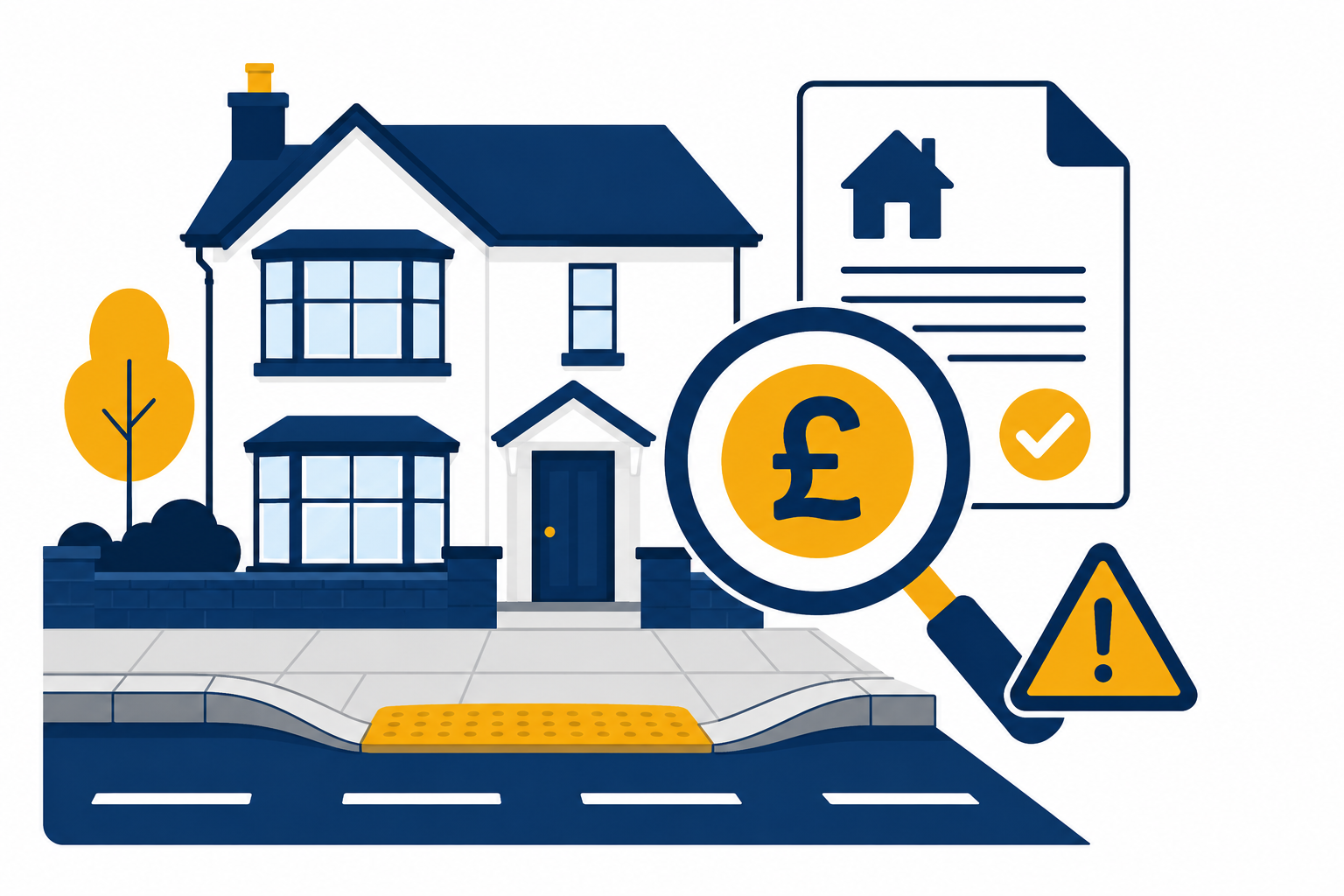
If you’ve lowered a kerb, or you’re about to, without going through your council first, the short answer is this: there’s no single national “dropped kerb fine.” What you’re exposed to is a stack of separate legal risks — a Penalty Charge Notice for driving over the pavement, an enforcement notice that can force you to rip the kerb back out at your own cost, and, in the more stubborn cases, a criminal prosecution with a fine on top. Which of those lands on you depends on which law your council chooses to use, and that’s the part most guides gloss over.
This article walks through each route separately, with the actual figures involved, because “you’ll get fined” isn’t a useful answer when you’re trying to work out whether to gamble on doing the work first and applying later.
Two Separate Approvals, Not One
Before the enforcement side makes sense, it helps to understand why councils have more than one lever to pull. A dropped kerb touches two different systems of control, and most homeowners only think about one of them.
Highway consent (the crossover itself). The physical work — cutting the kerb, reinforcing the footway so it can take vehicle weight — is controlled by the council in its role as highway authority, under Section 184 of the Highways Act 1980. This is the “can I build this” approval, and it’s separate from planning. You apply for it directly through your council — GOV.UK’s dropped kerb page will route you to the right local form.
Planning permission (the use of the access). Whether you’re allowed to create a new vehicle access at all is a planning question, covered by the Planning Portal’s dropped kerb guidance. It becomes unavoidable if your property sits on a classified A, B, or C road, if the building is listed or in a conservation area, if it’s a flat or commercial unit rather than a single house, or if the works disturb protected features like trees or a listed wall.
The trap is assuming that because you got permission for one, you’re covered for both. Planning consent to create a driveway on your front garden doesn’t automatically authorise the crossover itself, and a council-approved crossover doesn’t retroactively legalise a change of use that needed planning permission. Newham Council makes this distinction explicit in its own guidance, warning residents that garden-driveway planning permission is not the same thing as dropped kerb approval.
What Actually Happens If You Don’t Apply
There are three distinct enforcement paths, and they carry very different financial consequences.
1. Driving over the pavement without an approved crossing
This is the most common trigger, and often the first thing that happens even before anyone thinks about planning permission. If you’re mounting the kerb and crossing the footway to reach a driveway that doesn’t have a council-approved dropped kerb, that act itself is treated as unlawful use of the highway. Merton Council’s enforcement team has been explicit about this, stating plainly that driving over a pavement without a dropped kerb is illegal, and pursuing it through Penalty Charge Notices and, in persistent cases, physical bollards installed to block the crossing entirely.
This route doesn’t require a court appearance. A PCN is issued in the same way as a parking ticket, and repeated use of an unauthorised crossing can result in repeated notices.
2. Breaching a planning condition or ignoring an enforcement notice
If the council formally requires you to apply retrospectively or remove the kerb, and you don’t comply within the timescale set out in the notice, you move into criminal offence territory under the Town and Country Planning Act 1990’s enforcement provisions, as amended by the Levelling-up and Regeneration Act 2023. Knowingly breaching a condition imposed this way is a summary offence, and the fine is capped by reference to the “standard scale” set out in Section 122 of the Sentencing Act 2020. As of the current scale, that ceiling sits at £1,000 for a level 3 offence — though the court decides the actual amount within that limit, taking into account how serious the breach was and what the offender can reasonably afford to pay. Persistent, repeated non-compliance can escalate to further prosecution and, in the worst cases, a criminal record.
There’s a second, less obvious cost buried in this route. An enforcement notice that’s been served becomes a land charge — it attaches to the property, not just to you personally, which means it can surface in searches when you come to sell, even after the immediate issue is resolved.
3. The council builds or removes the crossing and bills you
Section 184(7) of the Highways Act gives the highway authority a more direct option: if you’re already driving over an unauthorised crossing, it can simply construct the proper vehicle crossing itself and recover its reasonable costs from you. The same logic runs in reverse for unauthorised works — where a kerb has been lowered without consent, the council can require reinstatement of the footway, and if you don’t do it, arrange the work and invoice you for it.
This is the scenario that tends to hurt the most financially, because you’re not just paying a fine — you’re paying to correct the physical work as well, on top of whatever penalty was imposed. Effectively, non-compliance can mean paying twice: once for the unauthorised work being undone, and again as the penalty for having done it without consent in the first place.
What the Numbers Actually Look Like
Because enforcement is discretionary and applied locally, there’s no fixed national fine table for dropped kerb breaches. What follows is the real range of costs people encounter, pulled from the mechanisms above rather than a single blanket figure.
| Cost type | Typical range | What triggers it |
|---|---|---|
| Council application fee (non-refundable) | Roughly £200–£300, varies by authority | Submitting the highway crossover application, whether or not it’s approved |
| Professional dropped kerb installation | Roughly £800–£1,500 | Standard cost of the physical works once approved |
| Penalty Charge Notice for illegal crossing | Set by the individual council’s parking enforcement policy | Driving over the pavement without an approved crossing |
| Planning enforcement fine (magistrates’ court) | Up to £1,000 (level 3 on the standard scale) per offence | Knowingly breaching a planning condition or ignoring an enforcement notice |
| Reinstatement/removal costs recovered by the council | Varies with the scale of the works — can run into the low thousands | Council carries out remedial work itself and bills the owner |
The application fee is worth flagging separately because it catches people out: it’s paid regardless of outcome. Newham Council, for example, charges a flat non-refundable fee simply to have the application assessed, before any construction cost is even discussed, and fees vary from council to council — Wokingham and Gloucestershire both publish their own separate fee schedules.
Why “I’ll Just Apply Retrospectively If Someone Notices” Is a Weak Plan
Retrospective applications are allowed in principle, but they don’t reset the clock. The council can still treat the period during which the unauthorised access existed as a breach, and a retrospective application can be refused just as easily as one submitted upfront — at which point you’re back to the removal-and-reinstatement scenario, except you’ve also paid for the original installation. If the property is on a classified road or in a conservation area, the odds of refusal are meaningfully higher, because those are exactly the situations planning permission exists to control in the first place.
There’s also a practical detection problem that works against the “hope nobody notices” approach. Councils pick these up through routine highway inspections, neighbour reports, and — increasingly — because an unauthorised crossing is visually obvious from the street. Merton’s bollard programme is a useful example of how far enforcement can escalate once a council decides a borough has a persistent problem: it moved from warning letters to physical infrastructure specifically to stop repeat offenders using unauthorised crossings.
A Practical Checklist Before You Start Work
- Confirm with your specific council’s highways team whether the crossing itself needs Section 184 consent — this is separate from planning and is checked first in most cases.
- Ask directly whether your road is classified (A, B, or C) — this single factor is the most common reason planning permission becomes mandatory rather than optional.
- If the property is listed, in a conservation area, or is a flat or commercial unit rather than a single dwelling, assume planning permission is needed unless the council confirms otherwise in writing.
- Get any approval in writing before a contractor touches the kerb — verbal assurances from a builder that “it’ll be fine” carry no legal weight if the council disagrees later.
- Budget for the non-refundable application fee separately from the installation cost, since you’ll pay it even if the application is refused.
- If you’ve inherited a property with an existing dropped kerb of unknown legal status, check its history before relying on it — an enforcement notice attached to a previous owner’s unauthorised works can still affect you as a land charge.
Useful Links
- GOV.UK: Apply for a dropped kerb — finds your council’s own application page
- Planning Portal: What is a dropped kerb? — plain-English overview of the process
- Planning Portal: Dropped kerbs and planning permission — when planning permission is and isn’t needed
- Planning Portal: Find your local planning authority — to check requirements directly with your council
- Highways Act 1980, Section 184 (legislation.gov.uk) — the primary legislation governing vehicle crossings
- Sentencing Act 2020, Section 122 — the standard scale of fines — statutory basis for the £1,000 (level 3) cap referenced above
- Levelling-up and Regeneration Act 2023, Section 120 — recent amendment to planning enforcement penalties
Frequently Asked Questions
Is there a fixed fine amount for an unauthorised dropped kerb?
No. There’s a statutory ceiling of £1,000 (level 3 on the standard scale) for the specific criminal offence of breaching a planning condition, but the amount within that limit is set by the court, and separate costs — PCNs, application fees, and reinstatement charges — sit outside that cap entirely and vary by council.
Can the council make me remove a dropped kerb I’ve already paid to install?
Yes, if it was installed without the required consent. The council can require reinstatement of the footway at your expense, in addition to any fine, and if you don’t act, it can carry out the work itself and recover the cost from you.
Does planning permission for a driveway include the dropped kerb?
No. These are assessed separately. Permission to lay a hard surface in your front garden does not authorise cutting the kerb — that requires its own highway consent, and potentially separate planning permission depending on the road classification and property type.
What if I only drive over the pavement occasionally — does that still count as an offence?
Yes. The offence is crossing the footway without an approved crossing point, not the frequency of doing so. A single instance can still result in a Penalty Charge Notice, and repeated use is more likely to draw formal enforcement attention.
Does an enforcement notice affect selling the property later?
It can. Once served, an enforcement notice becomes a land charge tied to the property rather than the individual, which means it can appear in conveyancing searches and needs to be resolved or disclosed when you sell.
This article explains the general legal framework in England and draws on Highways Act 1980, Town and Country Planning Act 1990, and Sentencing Act 2020 provisions, along with published council guidance. Rules and fee levels are set locally, so always confirm current costs and requirements with your own council’s highways and planning departments before starting work. This is general information, not legal advice.