
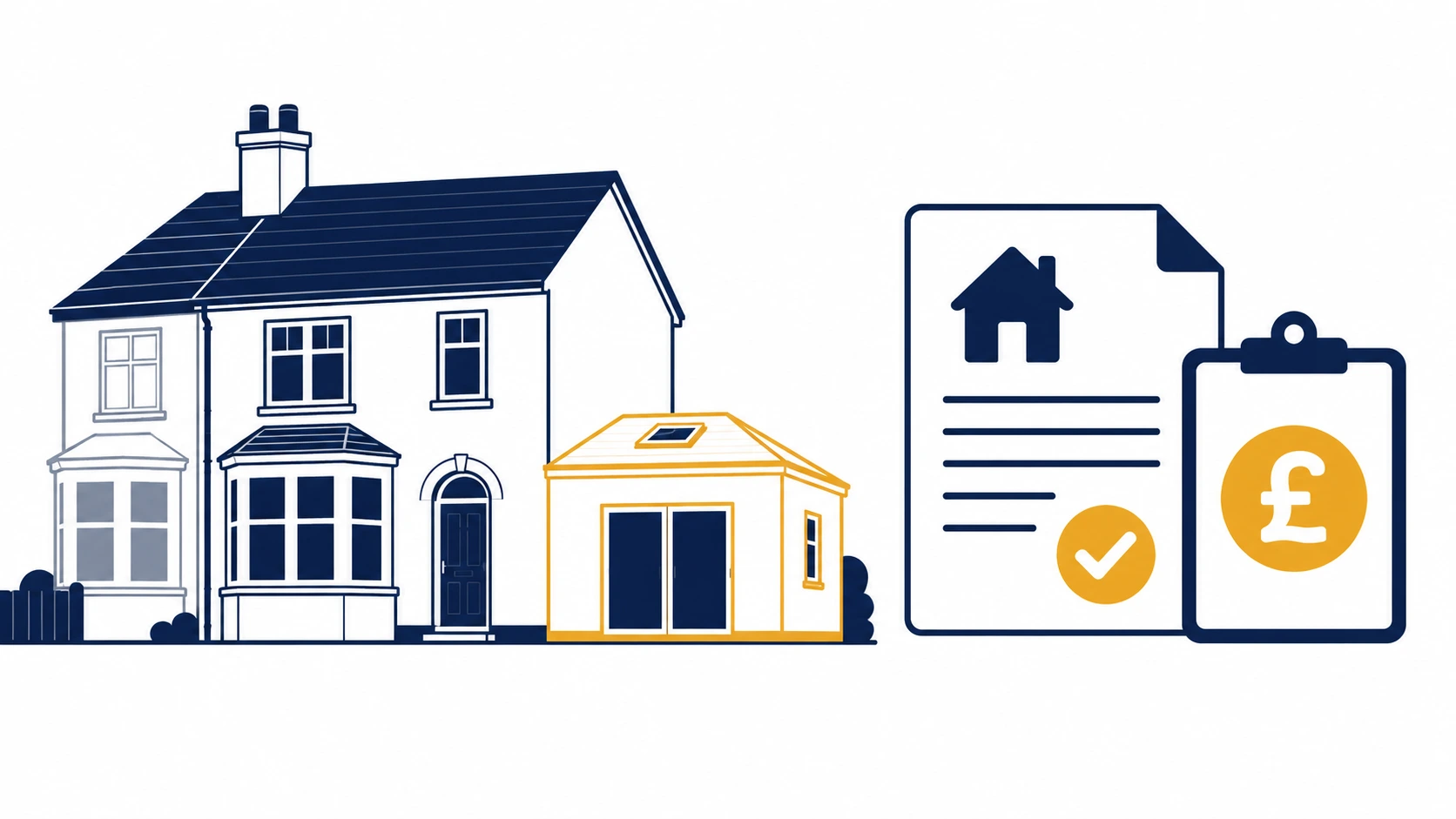
For a single-storey or two-storey extension to your home in England, the planning permission fee is £548, effective from 1 April 2026. This is a flat rate — it doesn’t change based on the size of the extension, whether it’s single or two-storey, or which room it’s for.
If your project is a smaller boundary structure (a fence, gate, or freestanding outbuilding) rather than an extension to the house itself, a separate, lower fee of £272 applies instead — covered below.
Not sure if you even need to pay this? Many extensions fall under permitted development rights and need no planning application — and therefore no fee — at all. That’s usually the first thing worth checking before you assume £548 applies to you.
👉 Use the calculator to confirm your exact fee
Why £548, specifically
This figure isn’t arbitrary — it comes directly from the Town and Country Planning (Fees for Applications, Deemed Applications, Requests and Site Visits) (England) Regulations 2012, as amended, and rises every April in line with CPI inflation. The April 2026 uplift was 3.8%, taking the fee from £528 to £548.
It’s a flat fee rather than one scaled to project size because a “householder application” (the formal name for this category) covers alterations and extensions to a single dwellinghouse as one fee band — regardless of whether you’re adding one bedroom or three. This is different from, say, a new-build application, where the fee scales with the number of dwellings.
What counts as a householder application
Your extension falls into this £548 category if it is:
- An enlargement, improvement, or alteration to a single dwellinghouse (not a flat)
- Within the boundary of your property
- Not creating a separate, self-contained unit
This covers most common extension types: rear extensions, side extensions, wrap-around extensions, and most two-storey extensions.
When a different fee applies instead
- Works within or along your boundary (not extending the house itself) — fences, gates, or a standalone outbuilding not attached to the house — fall under a separate, lower fee of £272.
- Extending two or more dwellinghouses in one application (e.g. a semi-detached pair, or an application covering more than one house) costs £1,083, not £548.
- Converting part of the extension into a separate flat or annexe with its own postal address typically moves you out of the householder category and into a full application, which is calculated differently — worth checking against the correct application type before you submit.
The worked example
Say you’re planning a two-storey side extension and, while you’re at it, also want to replace the garden fence.
- The extension itself: £548 (householder application)
- The fence: not a chargeable planning matter on its own in most cases, since fences under a certain height are usually permitted development — but if your fence does need consent (e.g. it exceeds height limits near a highway), that’s a separate £272 application, not bundled into the £548.
This is a genuinely common point of confusion — people assume one fee covers “the whole project,” when actually each distinct planning matter is assessed and charged separately.
Do you actually need to apply at all?
A large share of single-storey rear extensions in England are covered by permitted development rights and need no planning application — meaning no £548 fee. Broadly, you may be exempt if the extension:
- Doesn’t extend beyond specific depth limits from the original rear wall
- Doesn’t exceed certain height limits
- Isn’t on designated land (Conservation Areas, AONBs, etc., have tighter rules)
If you’re not certain, a Lawful Development Certificate can formally confirm you didn’t need permission — useful for future buyers and mortgage lenders, and covered in more detail in our certificates guide.
Check current permitted development rules directly via Planning Portal’s guidance.
Costs beyond the £548 fee
The £548 is only the statutory council fee. If you’re applying via the Planning Portal online, add the separate Planning Portal service charge, and factor in architect’s drawings, which are required for any application regardless of the fee. For the full breakdown, see our guide to the total cost of planning permission.
For the official, current fee schedule direct from government, see Gov.uk: Fees for planning applications.
Quick answer summary
- Single dwellinghouse extension: £548
- Boundary works only (fence, gate, small outbuilding): £272
- Extension covering two or more dwellinghouses: £1,083
- Many single-storey rear extensions: £0 (permitted development — check first)
Use the calculator above to confirm which category applies to your specific project.