
Planning Application Fees for New Houses in England (2026)
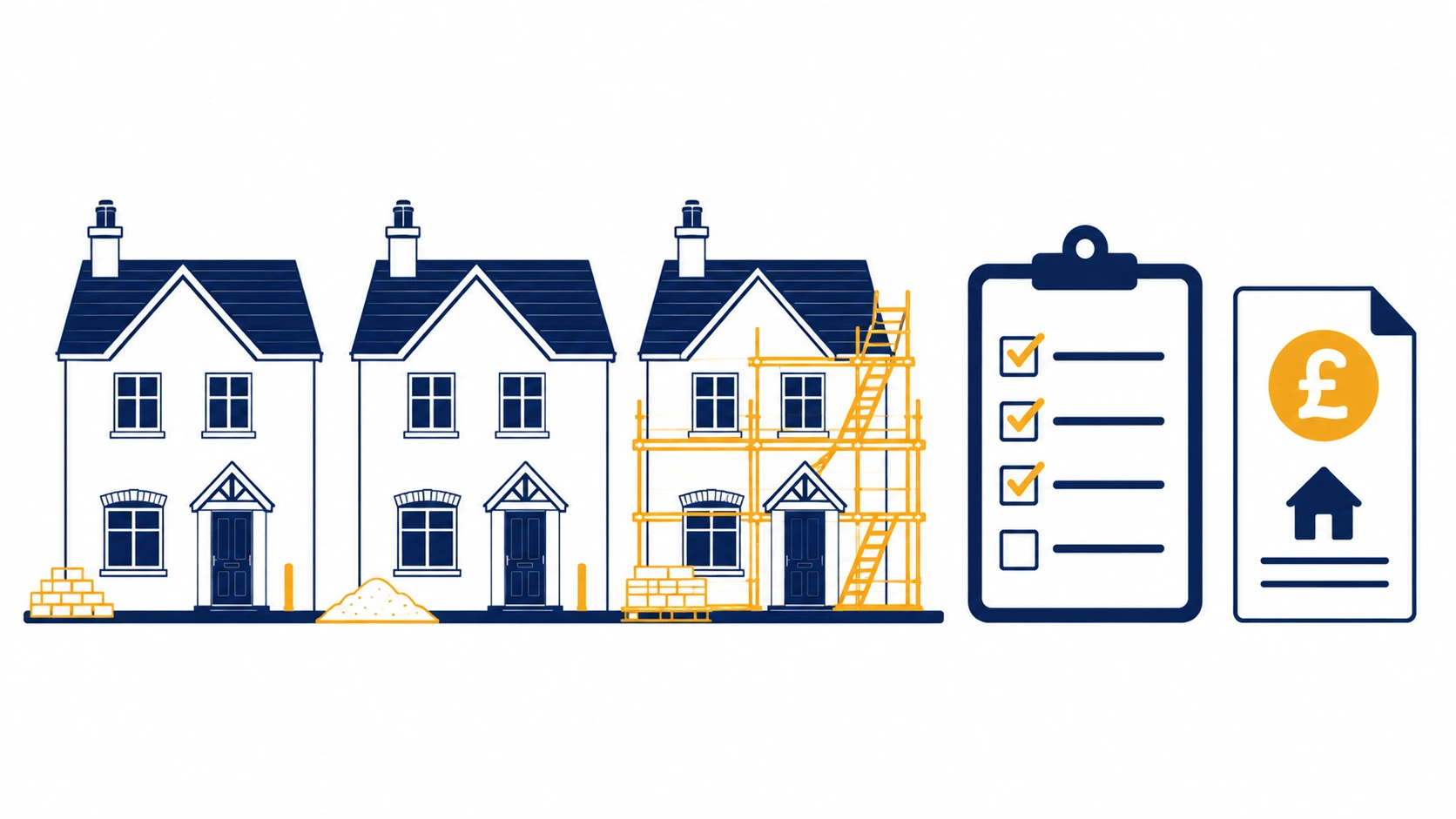
New housing is normally charged by the number of dwellinghouses proposed. From 1 April 2026, the main full-application bands are £610 per dwelling for 1 to 9 homes and £659 per dwelling for 10 to 50 homes. Larger schemes use a base amount plus a charge for each additional dwelling, subject to a cap.
Worked examples
A full application for three new houses falls in the first band: 3 × £610, or £1,830. A ten-home proposal moves all ten homes into the second band: 10 × £659, or £6,590. The band applies to the whole scheme, not only the dwelling that crosses the threshold.
Full permission and outline permission
A full application contains the detail needed for the council to decide the development. An outline application asks the council to decide whether development is acceptable in principle, with detailed matters dealt with later. Outline applications are calculated by site area and development category, so they should not be treated as a simple cheaper version of a full application.
If outline permission is granted, a later Reserved Matters application may have its own fee. The total cost and timetable depend on the proposal and the amount of detail left for the later stage.
Other costs are separate
The planning fee does not include drawings, surveys, ecology work, transport work, legal costs, infrastructure contributions, or building regulations charges. Those costs depend on the site and the scheme.
Enter the number of homes in the calculator to see the current banded estimate. The Local Planning Authority confirms the final category and fee.
Source: GOV.UK planning fee guidance. This page was reviewed on 18 September 2026.
Why the number of homes matters
New housing fees are commonly calculated by dwellinghouse within statutory bands, so the count must match the proposal being submitted. Do not use the number of bedrooms, floors, or units in a single building as a substitute for the number of dwellinghouses.
Questions to settle before calculating
- Is the application full permission, outline permission, reserved matters, or a different route?
- Are all proposed homes part of one application?
- Does the proposal include a change of use, demolition, or non-residential element?
- Has an outline fee already been paid, and what is being decided at the next stage?
Worked planning budget
Start with the statutory fee shown by the calculator. Then list surveys, transport or ecology work where relevant, drawings, design or planning advice, application amendments, and building-regulations costs separately. This prevents a per-dwelling fee from being mistaken for the full cost of obtaining permission.
Before payment: Compare the dwelling count and application route with the council’s validation checklist and confirm the final amount with the relevant authority.
What to record for a larger scheme
For a multi-home proposal, record the number of dwellinghouses, whether the application is full or outline, the site area, and whether non-residential development is included. These facts are more useful than recording only the final fee because they allow the estimate to be checked when the scheme changes.
A change from ten homes to eleven, a change from outline to full permission, or the addition of a commercial element may alter the fee basis. Do not assume that a revised drawing package leaves the original fee unchanged.
Applicant checklist
- Count proposed dwellinghouses consistently across the forms, plans, and fee calculation.
- Identify which matters are decided now and which are reserved.
- Check whether any earlier fee has already been paid and what it covered.
- Ask the authority how mixed-use elements should be described.
- Save the result, date, assumptions, and source links.
Source trail
Use the GOV.UK fees guidance and the underlying fee regulations together. The full-versus-outline guide explains why the route matters.